
What France has just changed
It slipped by in the middle of the summer, but it reshapes the maths for a lot of households. A French decree dated 13 July 2026, published in the official journal on 17 July and in force since 18 July 2026, adds reversible air-to-air heat pumps to the list of energy-renovation works that qualify for the reduced VAT rate of 5.5%.
In plain terms: fixed reversible air conditioning, the kind that cools in summer and heats in winter, moves from 10% to 5.5% VAT on an installer’s invoice. The symbolism matters as much as the money. For the first time, a product long filed under summer comfort is treated as an energy-renovation measure, alongside air-to-water heat pumps and insulation.
The conditions are strict and cumulative: the unit must be permanently installed, reach energy class A++ as a mono-split or A+ as a multi-split up to 12 kW (in heating and in cooling), use a refrigerant that meets the EU F-gas thresholds, accept temperature setpoints over a digital connection, and be fitted by a professional in a home completed more than two years ago. Miss one and the invoice goes back to the standard rate.
If you are reading this from the UK, none of that applies to you directly. But the logic will feel familiar, because HMRC reached the same conclusion three years earlier.
How the UK rule already works
Since 1 May 2023, installing energy-saving materials in residential accommodation in the UK has been zero-rated for VAT. The relief runs to 31 March 2027, after which it reverts to the reduced rate of 5%. Air source heat pumps are on the qualifying list, and that is the door through which air conditioning walks in: a fixed reversible split is an air source heat pump that happens to run its cycle backwards in July.
Two details in VAT Notice 708/6 do all the heavy lifting, and they are almost word for word the French test:
- Permanently fixed only. The guidance is explicit that only air source heat pumps that are permanently fixed, and are not portable or moveable, qualify as energy-saving materials.
- Installation, not retail. Supplying energy-saving materials without installing them is standard-rated. A retailer selling you a unit over the counter charges 20%, whatever the unit is.
So the two countries arrive at the same place by different routes: France through a reduced rate of 5.5%, the UK through a temporary zero rate. In both, the appliance you carry home in the boot of your car pays full VAT.
Why portable units never qualify
This is the question we field most often, and the answer rests on two reasons that stack.
It is not permanently installed
Neither text talks about air conditioners. Both talk about heat pumps intended to be permanently installed in a building. A single-hose monobloc that you wheel from room to room, whose duct sits in the gap of a half-open window and which goes back in the loft in October, plainly fails that test. It is not an oversight in the drafting, it is the definition itself.
There is no installation service
Relief attaches to a service: fitting, adapting or maintaining the equipment, with the hardware invoiced by the same business. It never attaches to a bare purchase. A portable air conditioner is bought off a shelf or online, you plug it in yourself, and no one invoices an installation.
That second reason carries a consequence many people miss: even a fixed split pays full VAT if you buy it on its own. Ordering a wall unit online and fitting it yourself, or having a friend fit it, means paying the standard rate on the hardware, on top of losing the warranty and the refrigerant handling certificate. The tax break and the qualified installer are a package deal.
None of which makes portable units second-rate. They remain the only realistic answer for a tenant, a difficult freeholder, a flat with no usable façade, or a genuine need of two weeks a year. We weigh that trade-off in our comparison of portable versus fixed air conditioners.
The awkward case of the pre-charged portable split
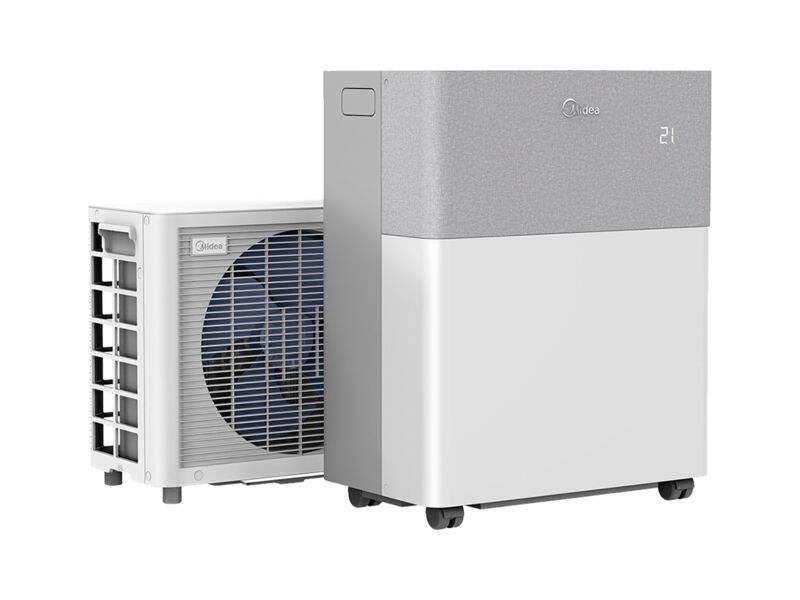
One family of products muddies the picture: pre-charged portable splits, of which the Midea PortaSplit 12,000 BTU is the best-selling example in Europe. They have the architecture of a fixed split, an indoor unit and an outdoor unit joined by a rigid line, but they install without drilling or vacuuming down: the outdoor unit sits on a balcony or hangs from a window ledge.
Technically they are very close to a fixed split. For tax purposes they are not. Both the French and the UK tests turn on permanent installation, and a machine designed to be unhooked, moved and refitted by its owner does not meet it. On top of that, there is usually no installation service invoiced at all, since dispensing with the installer is the whole sales pitch.
Verdict: full VAT, exactly like a monobloc. That is no reason to dismiss it, its 50 dB and its modest consumption make it a genuinely good compromise, but do not buy one expecting a tax break.
Who pays what: the table
Here is the sort, case by case, for the situations we actually see.
| Setup | UK VAT | France VAT | Why |
|---|---|---|---|
| Fixed reversible mono-split, high energy class, fitted by a professional in a home over two years old | 0% to 31/03/2027 | 5.5% | Meets every condition in both schemes |
| Fixed reversible multi-split, two or three rooms, fitted by a professional | 0% | 5.5% | France sets a lower class threshold for multi-splits |
| Fixed split bought online and fitted by you | 20% | 20% | Relief covers the installation, not the purchase |
| Fixed split fitted in a home under two years old | 0% if it is qualifying residential accommodation | 20% | France requires a dwelling completed over two years ago |
| Portable monobloc air conditioner | 20% | 20% | Not permanently fixed, no installation service |
| Pre-charged portable split | 20% | 20% | Designed to be moved, so not permanent |
| Evaporative cooler, fan, mister | 20% | 20% | These are not heat pumps |
That last line deserves a word, because it comes up constantly. An evaporative cooler is not a refrigeration machine: it evaporates water and lowers the temperature you feel, with no refrigerant circuit at all. No tax scheme has ever covered it, and its promise depends entirely on how humid the air already is, as we explain in our piece on air conditioners that need no exhaust hose.
What it actually saves
The two schemes are worth very different amounts, and it is worth seeing the gap.
- In the UK, a 3.5 kW reversible mono-split installed for £2,500 costs £2,500 with the zero rate, against £3,000 at the standard rate. That is £500 saved, and around £125 once the relief drops to 5% in April 2027.
- In France, the same job at €3,000 excluding tax comes to €3,165 instead of €3,300. That is €135 saved: real, but modest.
- On a whole-house multi-split at €12,000 excluding tax, the French cut is worth €540. The UK zero rate on an equivalent £10,000 job is worth £2,000.
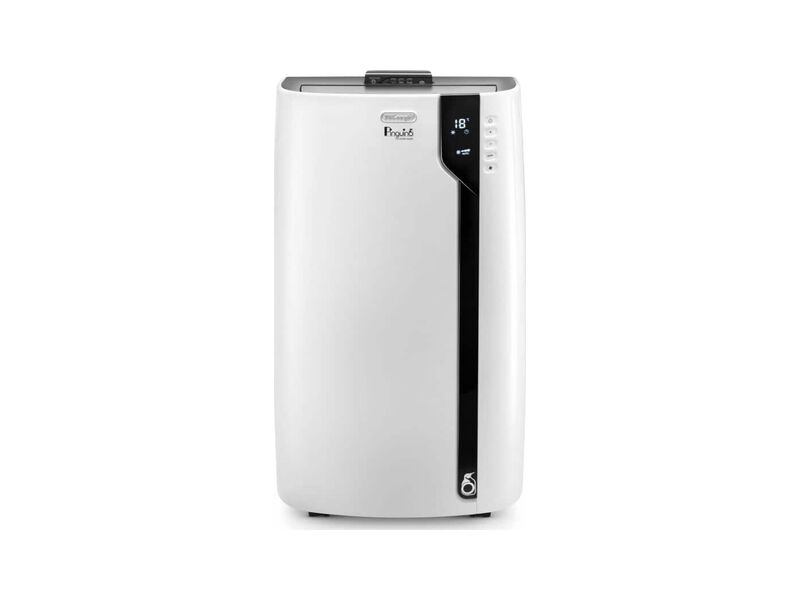
Either way, tax does not turn a project costing thousands into something comparable to a De’Longhi Pinguino PAC EX100 at a few hundred. The gap between portable and fixed stays an order of magnitude wide.
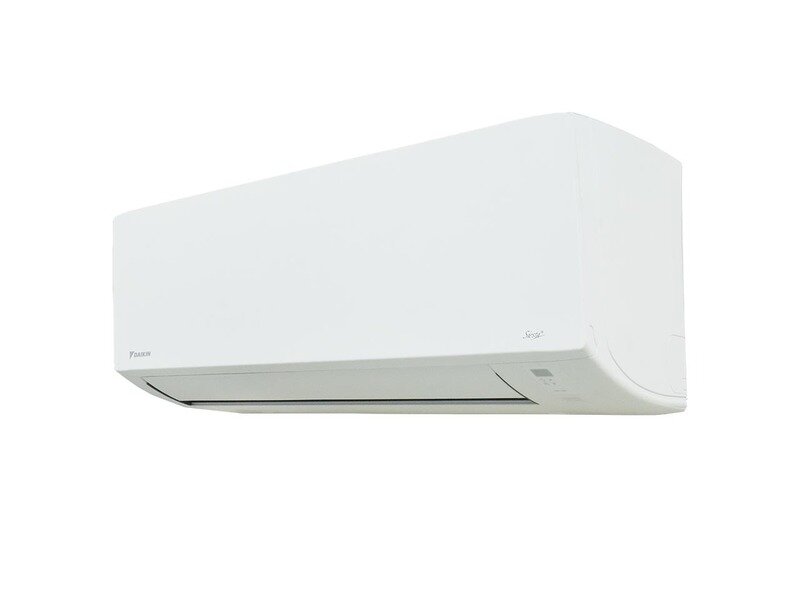
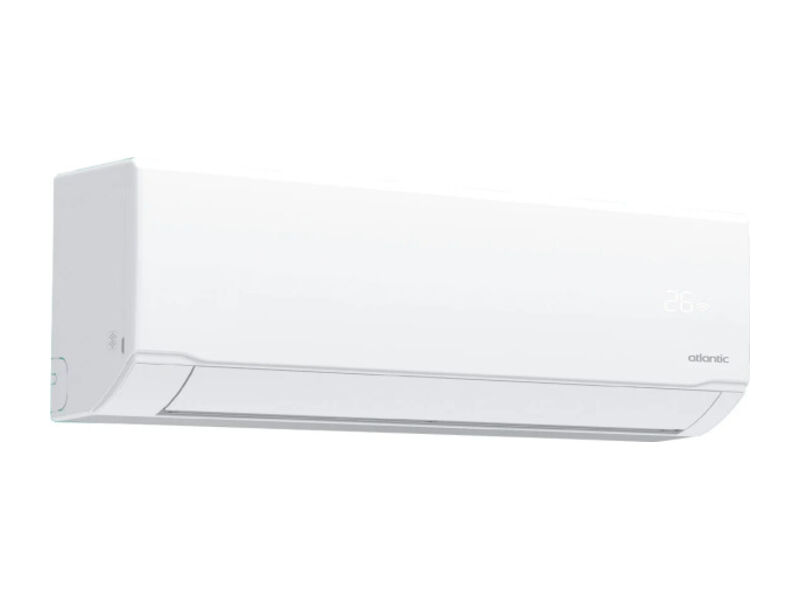
The real prize is elsewhere, and it is measured in years. A properly sized fixed split, such as a Daikin ATXC35E or an Atlantic Murao Access 3.5 kW, uses substantially less energy than a portable monobloc for the same comfort, because it is not dumping hot air through a hose in a window that has to stay ajar. And it heats in winter at an efficiency no electric convector comes close to. Over ten years, that difference decides the question, not a few points of VAT.
Should you switch to a fixed unit?
Our answer, as a shop that sells both: let the tax nudge the decision, not make it.
Fixed wins if you own the property, expect to stay several years, heat with electricity, and suffer more than about three weeks of heat a year. The dual role, an indoor unit running near 20 dB and running costs two to three times lower, settle it on their own. The tax relief is a bonus on top.
Portable still makes sense if you rent, if the building will not allow an outdoor unit, if you move often, or if your need is a handful of hot nights in one bedroom. A good monobloc properly set up, with the window gap sealed seriously, beats a bad split fitted in a hurry. Our guide to installing a portable air conditioner shows just how much that seal changes the outcome.
One last thought on timing. These measures land in a market already under strain, with installers quoting weeks of lead time and prices well up on last year, as we reported in our coverage of the 2026 rush. A tax cut during a shortage has a well-known side effect: some of it gets absorbed into higher quotes. The best time to have reversible air conditioning fitted is still autumn or winter, when diaries open up and negotiation becomes possible again. To get through until then, a setpoint of 26 °C, shutters closed by day and ventilation at night cost nothing in VAT at all.