A summer that refuses to loosen its grip
The 2026 season will be remembered across Europe. After an exceptional June and a peak of 37 French departments under red heat alert on 13 July, western Europe has strung together heatwave after heatwave with barely a pause. On Wednesday 5 August, a heat dome parked over south-eastern France kept 13 departments under orange heatwave warning, from the Rhône and Isère down to the Var, the Alpes-Maritimes, the Gard, the Vaucluse and Corsica.
What makes this episode punishing is not only the daytime maxima, close to 38 °C (100 °F) in the shade. It is the persistence, and the nights that never drop below 22 to 24 °C (72 to 75 °F). That single detail is what tips a home into lasting discomfort: without a window of night-time coolness, the building fabric never recharges, and indoor temperature creeps up day after day. The World Health Organization attributes roughly 489 000 deaths a year worldwide to heat, and stresses that prolonged episodes, rather than isolated spikes, carry the heaviest toll on vulnerable people.
Fan and air conditioner sales like nothing seen before
Market data tells the story better than any commentary. According to NielsenIQ, working with GfK Market Intelligence Sales Tracking, close to 1.9 million fans and air conditioners were sold in France between 15 and 28 June 2026, split into roughly 1.8 million fans and 160 000 air conditioners. In the single week of 21 to 28 June, the market passed one million units in seven days for the first time ever.
For scale: during the summers of 2024 and 2025, the hottest weeks topped out between 200 000 and 400 000 units. Over the twelve months to the end of April 2026, the French fan market alone accounted for 3.6 million units (around 170 million euros, up roughly 50 %), and portable air conditioners for 390 000 units worth close to 130 million euros, a rise of about 70 % in volume. France is simply the best documented market in Europe right now, and retailers in the UK, Spain, Italy and Germany have reported the same pattern of stock-outs.
| Benchmark | Fans | Portable air conditioners |
|---|---|---|
| Volumes, 15-28 June 2026 | Around 1.8 million units | Around 160 000 units |
| Market over 12 months (to end April 2026) | 3.6 million units | 390 000 units |
| Volume growth year on year | Around +50 % | Around +70 % |
| Annual revenue | Around 170 million euros | Around 130 million euros |
| Typical price bracket | Tens of euros | Several hundred euros |
The imbalance is telling: the fan remains, by a very wide margin, the mass answer to heat. Portable air conditioning grows faster in percentage terms, but from a base ten times smaller.
Empty shelves: why supply cannot keep up
A cooling season is ordered six to nine months ahead. Volumes are agreed in winter, manufactured in spring, shipped by container, then spread across warehouses. When demand doubles in a week, no replenishment can follow: there is simply no more stock in the country to move.
The retail figures are striking. Carrefour reported selling up to 200 000 air conditioners in a single week, close to half its annual sales in the category, and Fnac Darty shifted up to 10 000 units a day at the peak. The result: queues before opening, aisles cleared within hours, and a pattern experienced buyers recognise at once, the simultaneous disappearance of the cheapest models and the most expensive references. Back in 2025, the Dutch brand Duux had already sold through its entire French stock in six weeks.
Prices: what genuinely rose, and what is opportunism
In a market running out of stock, prices climb in two very different ways, and telling them apart matters before you reach for your card.
The first is mechanical and fairly ordinary: promotions vanish, entry-level models sell out first, and the average shelf price rises simply because only higher-end references are left. At the peak of the July episode, the average rise recorded on fans reached around 46 %, and the French consumer association UFC-Que Choisir documented an increase of roughly 22 % in four weeks on portable air conditioners between June and July 2026.
The second is far more questionable: on some online marketplaces, third-party sellers repriced units far beyond any reasonable value, with a portable air conditioner listed at around 300 euros a few weeks earlier changing hands above 1 000 euros. That is not a market movement, it is opportunism.
What a portable air conditioner really costs to run
The purchase price is only half the equation. ADEME puts the consumption of a portable air conditioner at roughly 710 kWh a year. A simple calculation confirms the order of magnitude: a 900 W unit running 6 hours a day for 90 days uses around 486 kWh, which you can price directly against your own electricity tariff.
Two technical points are worth knowing before you buy. First, the structural limit of single-hose units: the exhaust duct forces you to leave an opening in the window, and the hot outside air drawn in cancels part of the machine’s work. That is precisely why ADEME rates portable air conditioners as a poor solution unless the window is properly sealed. Second, regulation: a conventional model swings by about ±2 °C around the set point, against roughly ±0.5 °C for an inverter unit, which modulates compressor speed instead of switching fully on and off, with up to 30 % electricity savings.
Our comparison of portable and fixed air conditioners breaks those efficiency gaps down with figures.
Buy now, or wait for the end of summer?
The honest answer depends on your situation, and we have no interest in pushing you towards a purchase you will regret in October.
Buying now makes sense if your home houses an older person, an infant, someone who is ill or pregnant, or if you work from a room that stays above 30 °C (86 °F) for days on end. At that point discomfort is no longer about comfort but about health, and a 40 euro fan available today beats a perfect air conditioner delivered in September.
Waiting makes sense if you are after lasting equipment rather than a stopgap. End-of-season clearances, usually from the second half of September, bring prices back to normal and leave time to compare noise level, consumption and the capacity genuinely suited to your room. It is also the right moment to consider a fixed installation, or solar shading that treats the cause rather than the symptom.
Our benchmarks for a useful purchase, even in a hurry
If you have to buy this week, here are the three or four criteria that genuinely make a difference, product family by product family.
A fan: look at airflow and noise, not the silhouette
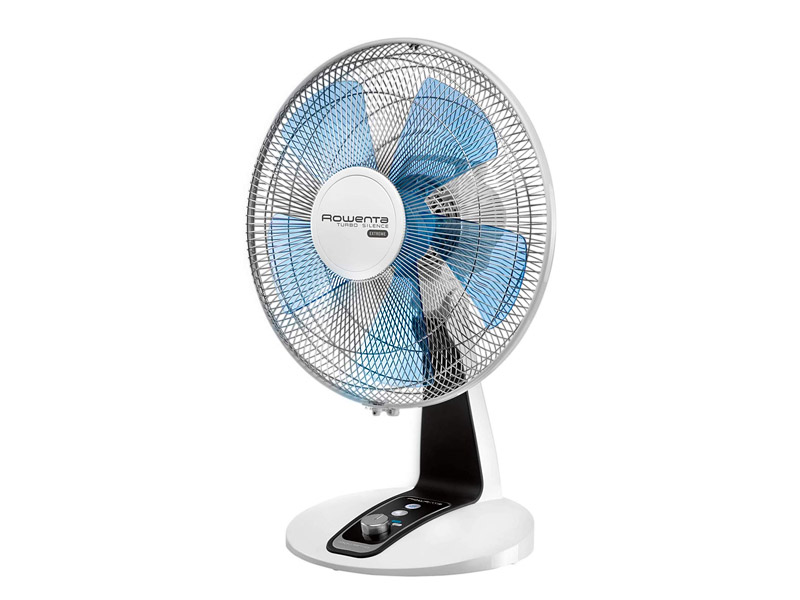
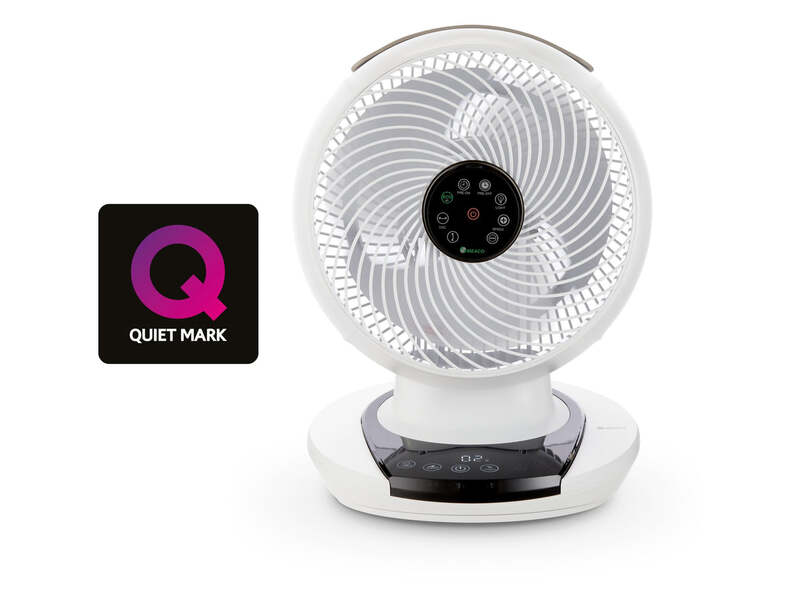
A fan does not cool the air, it speeds up the evaporation of sweat and buys you 3 to 4 °C of perceived temperature. The two numbers that matter are airflow, in m³/h, and noise level in dB(A): beyond 55 dB(A), the sound becomes intrusive in a bedroom. Wide oscillation (90° and above) avoids the fixed, drying airflow. In our fan selection, a simple, well built model such as the Rowenta VU2630F0 covers most needs, while the MeacoFan 1056 targets those who put silence first. Our pedestal versus tower fan comparison settles the question of shape.
A portable air conditioner: capacity must match the room
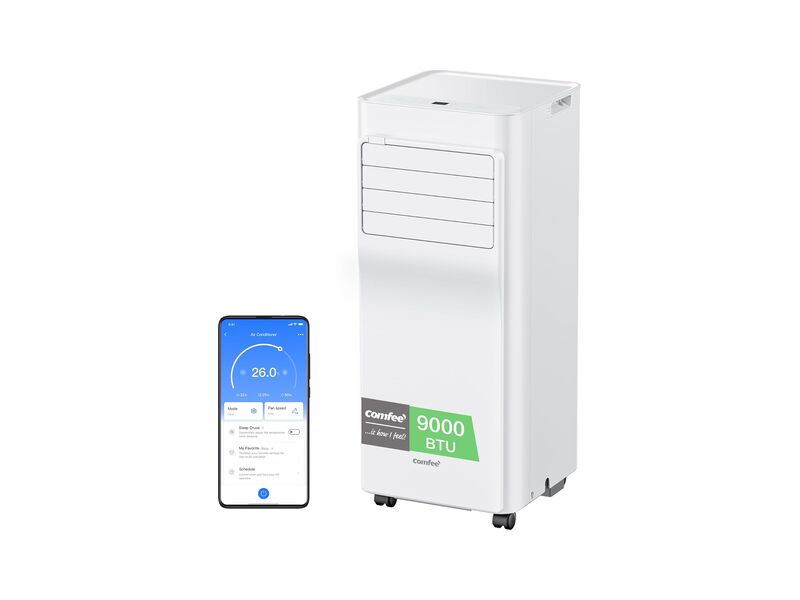
Budget roughly 100 W of cooling capacity per square metre in a reasonably insulated home, so broadly 7 000 BTU for 20 m² and 9 000 to 12 000 BTU for 30 m². Oversizing raises consumption without improving comfort; undersizing condemns the unit to run non-stop. Also check the energy class and whether a window sealing kit is included, as it is too often sold separately. Our air conditioner section covers each model in detail, including the Comfee Breezy Cool 2.6.
Outdoors: misting rather than cooling
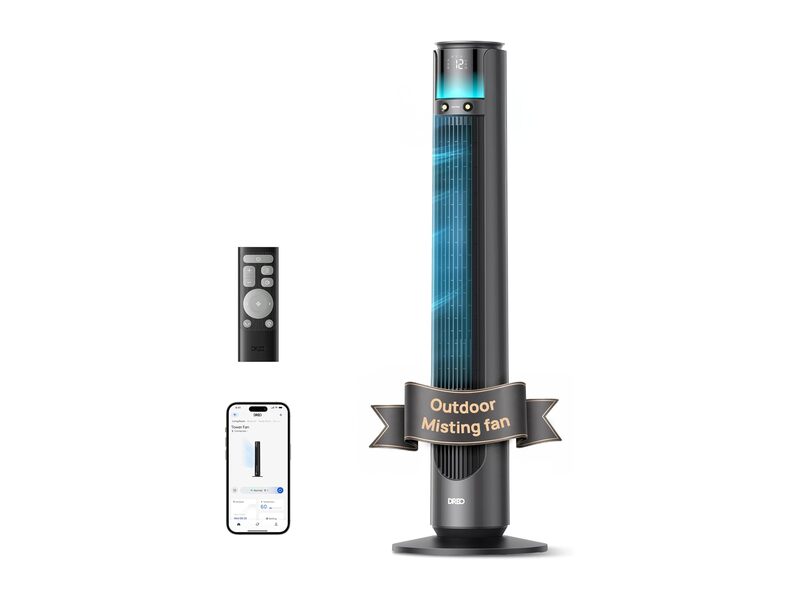
On a terrace or a balcony, air conditioning makes no sense at all. Misting, on the other hand, drops perceived temperature by several degrees by exploiting the evaporation of fine droplets, for a negligible electricity draw. A misting fan such as the DREO TurboCool 711AS combines both effects, and our mister section covers the other formats. One caveat: the principle loses much of its effect when the air is already humid.
Finally, a reminder that costs nothing: closing shutters and curtains during the day, ventilating at night as soon as the outdoor temperature falls below the indoor one, and switching off unnecessary appliances remains the most cost-effective measure of all. Our guide on choosing between a fan and an air conditioner applies that logic room by room.