Pedestal fan or tower fan: two shapes for the same job
A pedestal fan and a tower fan (also called a column fan) share the same goal: moving the air in a room to speed up the evaporation of sweat and create a feeling of coolness, without ever lowering the actual room temperature, unlike an air conditioner (see our fan or air conditioner guide). Their shape, however, differs a great deal.
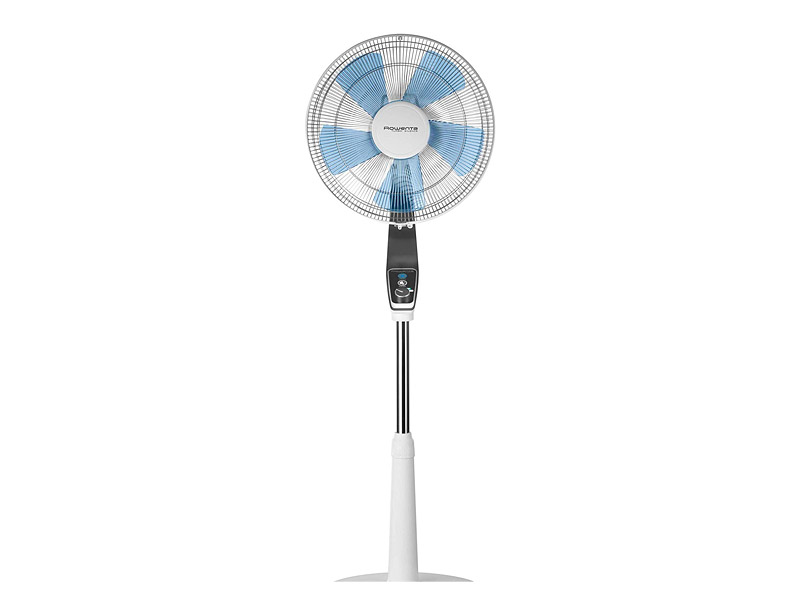
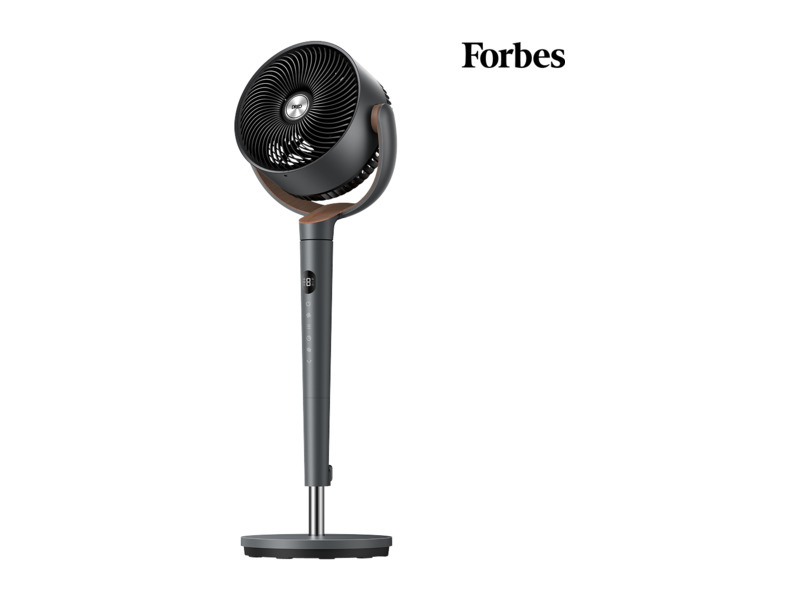
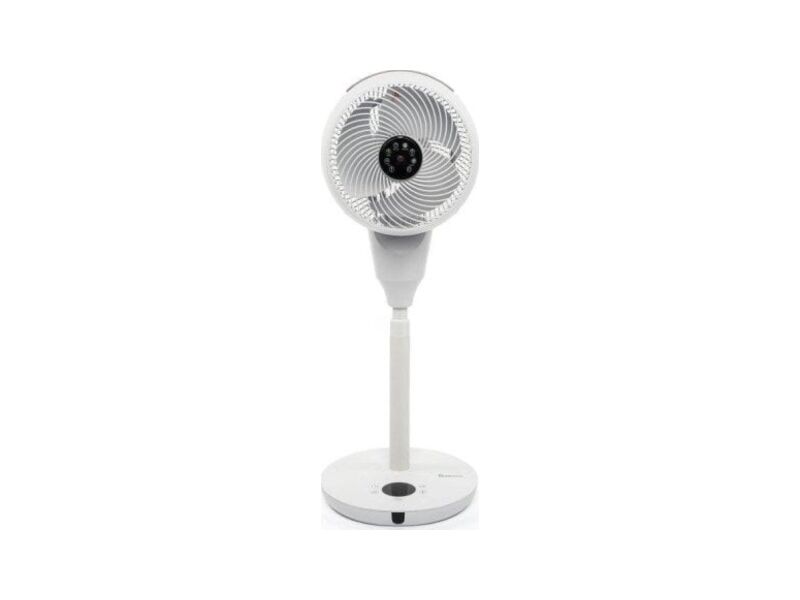
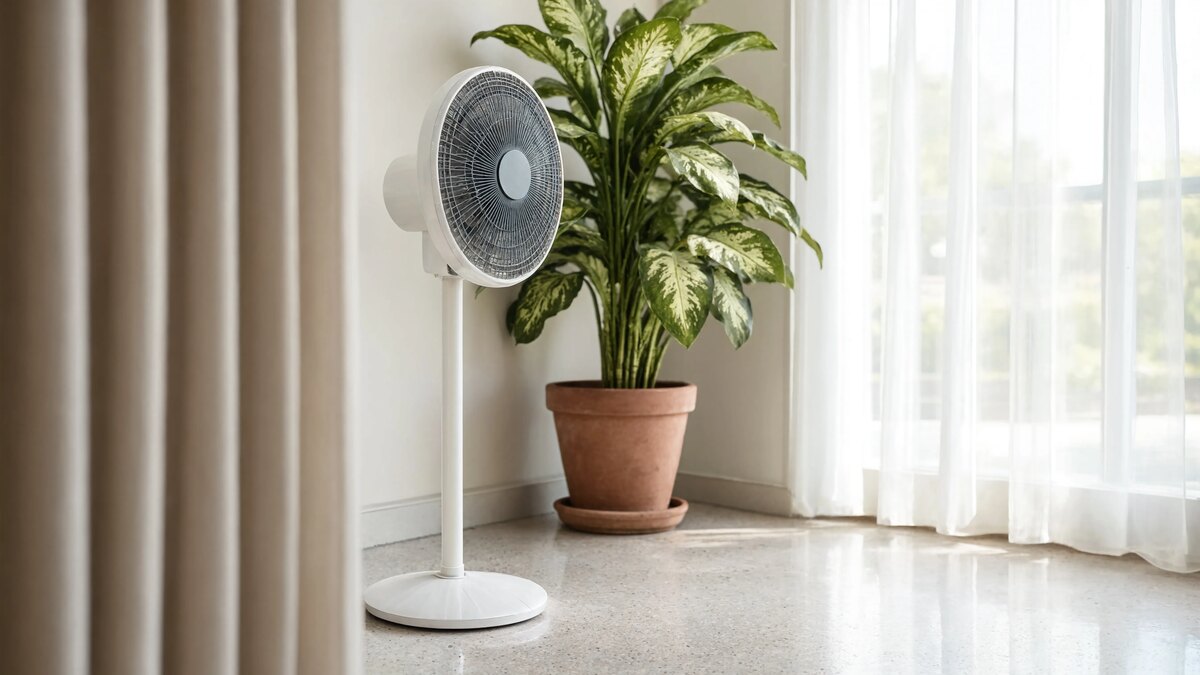
The pedestal fan follows the classic layout: a round head with visible blades, protected by a grille, mounted on a pole that is often height-adjustable, sitting on a wide base for stability, even at top speed.
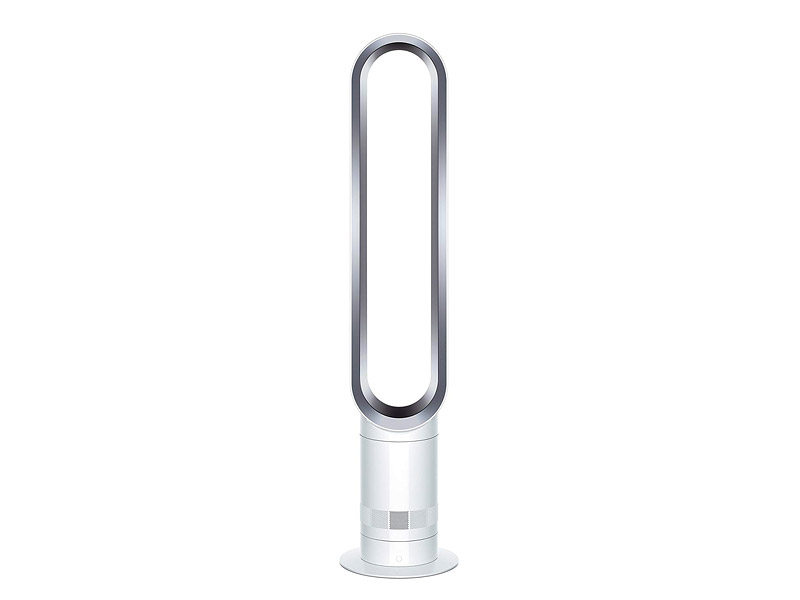
The tower fan takes a slim, tall, vertical profile, usually around a metre high. The blades sit hidden behind vertical slats on classic models, or are completely absent on the most premium models fitted with air-amplifying technology such as Dyson's Air Multiplier.
Airflow: the shape doesn't tell the whole story
Airflow, measured in m³/h or litres per second, tells you how much air the appliance moves: the higher the figure, the stronger the breeze and the faster the room cools down. It's a spec often wrongly assumed to track the shape, when in fact it mainly depends on blade size, motor power and the housing design, not the silhouette of the unit.
In our catalogue, the Rowenta VU5640F0, which we classify as a tower fan, delivers up to 72 m³/min (roughly 4320 m³/h) on Turbo Boost, comfortably ahead of the Dyson AM07, another tower fan, which tops out at 500 l/s (about 1800 m³/h). Conversely, a pedestal fan such as the Meaco MeacoFan 1056P is rated at 1065.6 m³/h. The lesson is clear: always check the stated airflow figure rather than assuming a shape tells you how powerful the breeze will be.
Noise: which format is really the quietest?
Noise level is measured in dB(A): as a benchmark, a quiet bedroom at night sits around 30 dB, and a normal conversation around 60 dB. Again, shape does not determine how quiet a unit is, motor technology does.
Models fitted with a DC (direct current) motor, pricier to build but noticeably quieter and more efficient than a standard AC motor, turn up on both pedestal and tower fans. In our selection, it's a pedestal fan, the DREO TurboPoly 512, that goes the lowest at 20 dB on its slowest speed, ahead of the Meaco 1056P (29 dB), also a pedestal model. The Dyson AM07, despite its premium positioning, sits at 28 dB in night mode but climbs to 56 dB at full power, roughly the level of a hairdryer.
Oscillation and room coverage
Oscillation determines how much of the room the airflow sweeps across. Most pedestal and tower fans oscillate horizontally between 60° and 120°. Some higher-end pedestal models add vertical oscillation too: the Meaco 1056P combines 80° horizontally with 60° vertically, together or separately, letting air bounce off walls and ceiling rather than sticking to a single band in front of the unit.
Tower fans, being slimmer and taller, usually settle for more modest horizontal oscillation: the Dyson AM07 tops out at 70°, while the Rowenta VU5640F0 reaches 120°. For a large or narrow living room, it's worth checking the stated oscillation angle rather than assuming one format automatically covers more ground.
Footprint, stability and how it fits your decor
On paper, a tower fan always looks more compact thanks to its slim vertical profile, designed to slot into a corner or hug a wall without sticking out. In practice, floor footprint mostly comes down to the individual model: the DREO TurboPoly 512, classified as a pedestal fan, sits on a 30 x 30 cm base, more compact than the 45 x 43 cm base of the Rowenta VU5640F0, which is classified as a tower fan.
Height is where the two formats really diverge: a pedestal fan typically adjusts between 90 cm and 135 cm to suit sitting or standing use, while a tower fan usually stays fixed, around a metre tall. On looks, the tower format, sleeker overall, tends to blend more easily into a contemporary room, while the pedestal format leans more utilitarian, except on design-led versions such as chrome retro-style models.
Safety: which is safer around children and pets?
For a household with young children or curious pets, safety deserves close attention. On both a classic pedestal fan and a tower fan with blades hidden behind slats, a protective grille built to current electrical safety standards greatly reduces the risk of trapped fingers, without ever fully removing it for very young children.
The real difference shows up on bladeless tower fans, such as the Dyson AM07: the air is amplified with no accessible blade at all, removing the trapping risk entirely, and the unit shuts off automatically if it's knocked over. That's a strong argument for families with toddlers or pets that like to play around furniture.
Whatever format you choose, never leave a fan running unsupervised within reach of a child under 3, and unplug it when it's not in use.
Maintenance and dust: which takes more effort?
The pedestal fan has an often-overlooked advantage: its round grille usually comes apart at the front and back (clips or screws depending on the model), giving direct access to the blades for a thorough clean with a cloth or a vacuum brush attachment.
The classic tower fan, with fixed vertical slats, can paradoxically take more effort: the grille is usually not removable, and dust builds up along each slat, only reachable with a narrow vacuum nozzle or a can of compressed air. Only bladeless models like the Dyson AM07 flip that around entirely: their smooth surface wipes clean in seconds with a damp cloth, no disassembly needed.
What budget should you plan for each format?
The pedestal fan covers the widest price range: expect around £20 to £40 for an entry-level model with a standard motor, £60 to £130 for a premium, quiet DC-motor model like the DREO TurboPoly 512, and up to £200 or more for the most accomplished options such as the Meaco 1056P, which holds a Quiet Mark award for its low noise.
The tower fan sits in a narrower and generally pricier segment: classic slatted models start around £100 to £150, while premium bladeless models like the Dyson AM07 go past £450 to £500. That premium buys you design, stronger safety credentials and, often, a remote control as standard.
Our comparison table
| Criterion | Pedestal fan | Tower fan (column) |
|---|---|---|
| Shape | Round head with visible blades on a pole, wide base | Slim vertical profile, compact base |
| Airflow | Varies by motor, from 1000 to over 4000 m³/h | Varies by motor, not automatically higher |
| Noise level | From 20 dB on premium DC-motor models | 28 dB to 45 dB in normal use, up to 56 dB at full power |
| Oscillation | 60° to 120°, sometimes dual axis (horizontal and vertical) | Usually 70° to 120°, horizontal only |
| Child/pet safety | Standard protective grille | Standard grille, or maximum safety on bladeless models |
| Maintenance | Removable grille, easy access to blades | Fixed slats can be fiddlier, except bladeless models (very easy) |
| Average budget | £20 to over £200 | £100 to £500+ |
| Best suited for | Any budget, strong airflow, best noise for the price | Design-led interiors, maximum safety, bigger budget |
Our verdict: which format suits your situation
If your priority is airflow and quiet running at the best price, a pedestal fan remains the most sensible pick: choice is wide, from entry-level units to premium DC-motor models running under 30 dB.
If you have young children or curious pets, or if fitting neatly into your living room's look genuinely matters to you, a bladeless tower fan like the Dyson AM07 earns its higher price through safety and design that a pedestal fan simply can't match.
In between, a classic slatted tower fan remains a fair compromise, as long as you're prepared for maintenance that can be a bit more fiddly. To narrow things down, browse our full range of fans, filterable by shape, noise level and budget.