
The basics: why evaporation cools the air
An evaporative air cooler and a mister both rely on the same physical principle, one quite different from a proper air conditioner: the evaporation of water. A fan pushes air through a wet pad (cooler) or through a cloud of fine droplets (mister), and the water that evaporates on contact with that air absorbs heat as it changes state, from liquid to vapour.
That heat is drawn straight out of the surrounding air, which comes out noticeably cooler than it went in. It's the same phenomenon that makes you feel a chill stepping out of a pool, or that cools a room when wet laundry is drying in it: evaporating water consumes energy, and that energy is taken as heat from the surrounding air.
Latent heat of vaporisation: the real engine behind it
The technical name for this principle is the latent heat of vaporisation: the energy needed to turn liquid water into vapour without even raising its temperature. For one litre of water, that's roughly 2,260 kilojoules, far more than what's needed to heat that same litre from 0 °C to 100 °C by simple heating.
Inside a cooler or a mister, that energy is drawn from the air passing through the wet pad or the droplet cloud. The more complete and rapid the evaporation, the more heat is pulled from the air, and the bigger the temperature drop you feel. It's a purely physical mechanism, with no compressor and no refrigerant gas: that's exactly why these devices use far less electricity than an air conditioner.
Why humid air blocks the effect
This is where the problem sits. Air can only hold a limited amount of water vapour before it becomes saturated, and that limit depends on temperature: the warmer the air, the more vapour it can hold before saturating. Relative humidity (the percentage shown on a weather app or station) simply measures where the air sits between 0 % (dry air) and 100 % (saturated air, fog or rain).
Evaporation, by definition, moves water from liquid to vapour, and it can only happen if the air still has room to accept that vapour. In air already sitting at 70 or 80 % relative humidity, that room shrinks sharply: water in the pad or the droplets evaporates far more slowly, so it pulls far less heat out of the air, and the unit ends up adding humidity without really lowering the temperature. That's exactly the feeling of an evaporative cooler that “does nothing” on a muggy, thundery day.
Wet-bulb temperature: the theoretical ceiling of evaporative cooling
Physicists and climate engineers have a name for this ceiling: wet-bulb temperature. It's measured with a thermometer whose bulb is wrapped in a wet wick and placed in an airflow: it's the lowest temperature a purely evaporative process can ever reach, no matter how powerful the fan or how good the pad.
The drier the air, the bigger the gap between the usual (“dry-bulb”) temperature and the wet-bulb temperature, and the more cooling headroom is available. The more humid the air, the narrower that gap gets, until it's almost nothing on very muggy days. As a rough, indicative guide:
| Relative humidity | Achievable temperature drop | Evaporative cooling effectiveness |
|---|---|---|
| Below 30 % | 8 to 15 °C | Very good, typical of dry climates |
| 30 to 50 % | 4 to 8 °C | Good, typical everyday use |
| 50 to 65 % | 2 to 4 °C | Moderate, noticeable but limited |
| Above 65 to 70 % | Under 2 °C | Essentially nil, air already near saturation |
These figures explain why evaporative cooling works very well in a dry continental climate during the day, but disappoints during a summer thunderstorm or a muggy tropical night, when relative humidity climbs while the heat itself doesn't drop.
Indoor cooler or outdoor mister: same physics, very different settings
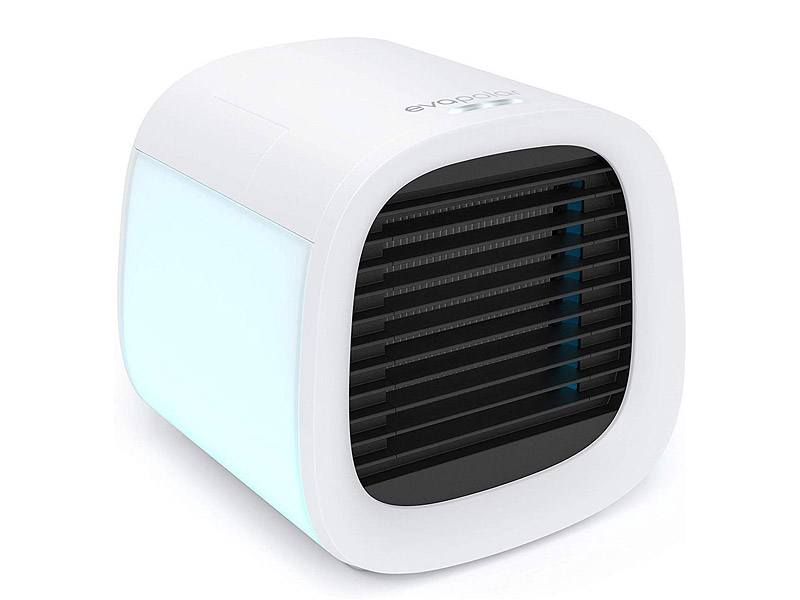
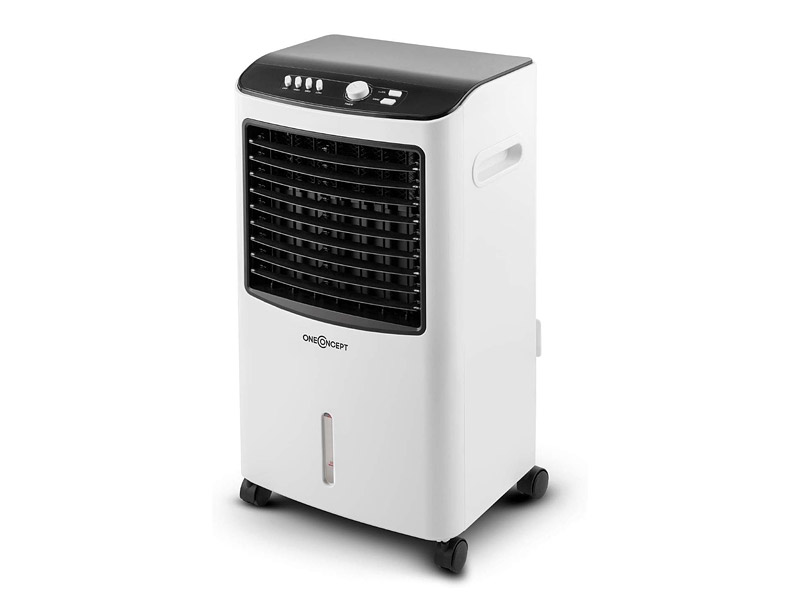
An evaporative cooler like the Evapolar evaCHILL or a OneConcept MCH-2 works inside an enclosed space, a bedroom or an office. The moisture it adds stays trapped in that room: past a certain point, it doesn't just stop cooling, it starts making the air feel heavy and sticky, an effect many users notice without quite understanding the cause.
An outdoor patio mister runs into exactly the same physical limit tied to humidity, but in a very different setting: outdoors, air constantly refreshed by the breeze disperses the added moisture instead of letting it build up. That's why a mister stays broadly useful outdoors even on a day when an equivalent indoor evaporative cooler would clearly disappoint.
Does ultrasonic misting really change the equation?
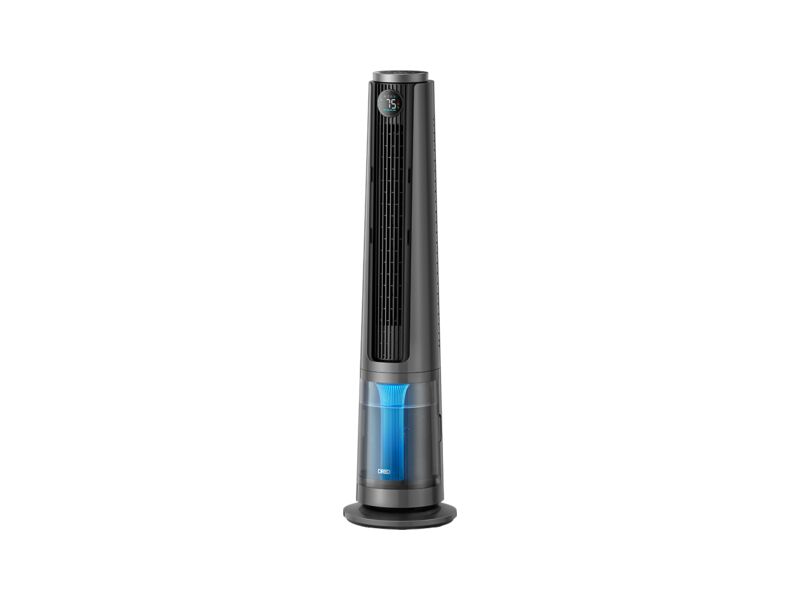
Some manufacturers, such as Dreo with its TurboCool range, promote ultrasonic misting that produces far finer droplets (down to a few microns) than classic low-pressure misting, specifically to limit the over-humidification often blamed on traditional evaporative coolers.
That reasoning holds up physically: smaller droplets do speed up and complete evaporation, which cuts down on that damp, dripping feeling. But it changes nothing about the fundamental limit set by wet-bulb temperature: the same amount of water still has to evaporate to produce the same cooling effect, and the air still saturates just as fast in an already humid climate. Ultrasonic misting improves comfort of use (less of a damp feeling on contact), not the technique's physical ceiling.
How to tell if your air is too humid for this kind of device
Before blaming the unit, a simple check: look up the relative humidity on a weather app or a connected station. A few practical benchmarks:
- Below 50 %: an evaporative cooler or a mister remains effective, with a clear temperature drop.
- Between 50 and 65 %: the effect becomes moderate, often felt more as airflow (fan effect) than as a real drop in temperature.
- Above 65 to 70 %: effectiveness drops sharply; an indoor cooler risks adding discomfort (sticky air) rather than removing it.
Another telling sign: if the air coming out feels noticeably heavier or damper without any real sense of coolness, that's the classic symptom of humidity already too high for this physical principle, not a fault or a manufacturing defect.
Air conditioner or evaporative cooler: choosing by climate
This physical limit draws a fairly clear line between the two technologies. An air conditioner genuinely removes heat from a room via a refrigeration cycle (see our feature on portable AC without a hose) and works regardless of ambient humidity, with the bonus of drying the air too. An evaporative cooler remains unbeatable on price and running cost, but only in a dry to moderately humid climate.
To decide, it's worth checking your local climate rather than just the budget: dry continental or Mediterranean daytime conditions, an evaporative cooler largely delivers on its promise. Damp, oceanic or during a very humid thundery spell, only a proper air conditioner, as detailed in our comparison of portable versus fixed air conditioners, brings reliable relief.