
Van life is a market that’s reshaping the fridges vans carry
Van life is no longer a niche pursuit. The National Caravan Council (NCC), the UK trade body for the sector, has logged repeated multi-year highs in new motorhome and campervan registrations, including a record 16,608 new UK registrations in a single 12-month period, up 8.25% on the previous high. That sustained growth feeds straight through to the equipment fitted on board, and one item in particular sits at the heart of everyday comfort: the fridge.
For a long time, the choice barely came up: a van or motorhome was fitted almost automatically with an absorption fridge, the so-called three-way type (gas, 12V, 230V). Over the past few years, that’s changed fundamentally. Powered by compressors that keep getting smaller and more efficient, compressor fridges have been steadily winning ground, to the point of becoming the default choice for most professional converters and DIY van builders alike.
Why the absorption fridge dominated vans for so long
An absorption fridge runs with no moving mechanical parts at all: a mix of water, ammonia and hydrogen circulates in a closed loop, driven by a heat source, an electric heating element on 12V or 230V, or a propane/butane gas flame, with no compressor and no conventional refrigerant gas. That total absence of moving parts makes it a genuinely silent appliance, a real asset in the confined space of a van, which explains why it equipped almost every motorhome sold from the 1980s and 1990s onward.
The technology still carries two structural limits, well known to experienced users. First, a real sensitivity to tilt: manufacturers generally recommend not exceeding 3° to 6° of sustained incline, beyond which fluid circulation gradually degrades, with a risk of damaging the circuit over time. Second, modest energy efficiency: running on electricity, the heating element draws power continuously, typically in the region of 120 to 180 W depending on the model and outside temperature, for a cooling result that’s often slower than a compressor, particularly once it gets hot outside.
Compression takes back the lead: miniaturisation and variable-speed compressors
A compressor fridge works on the same principle as a household fridge: an electric compressor compresses a refrigerant gas, which then expands in an evaporator, absorbing heat from inside the cabinet. Long considered too bulky, too power-hungry and too noisy for mobile use, that principle has undergone a genuine miniature revolution over the past decade, driven largely by variable-speed (inverter) compressors of the Danfoss/Secop BD type, a near-universal reference across the industry.
Unlike a conventional compressor, which only knows two states (running flat out or fully off), a variable-speed compressor continuously adjusts its rotation speed to match the actual cooling load. The result: noticeably lower power draw, faster cooldown, capable of holding a set point around 4 °C with good stability, or dropping below -18 °C in freezer mode on combined units, and quieter running overall, since the compressor spends most of its time turning at low speed rather than repeatedly kicking in at full power. Another notable shift: synthetic refrigerant gases with a high global warming potential are steadily being replaced by natural gases such as R600a or R290 (propane), driven by a combination of technical progress and the European timetable for phasing down fluorinated gases (F-Gas).
Absorption or compression: what actually changes
On paper, switching to compression changes several everyday parameters on board. Here are the main differences, for comparable equipment and volume.
| Criterion | Absorption (three-way) | Compression (inverter) |
|---|---|---|
| Sensitivity to tilt | High, 3° to 6° maximum recommended | Low to none |
| Average power draw | Around 120 to 180 W continuous (12V/230V mode) | Around 30 to 50 W on average (cyclical operation) |
| Cooling speed | Slow, sensitive to outside temperature | Fast, stable even in high heat |
| Noise | Virtually silent, no moving parts | Low, variable-speed compressor (30 to 40 dB(A) typical) |
| Size for equal volume | Bulkier (external heat exchanger) | More compact, compressor sometimes remote-mounted |
| Power sources | Gas, 12V, 230V (three-way) | 12V/24V and/or 230V depending on model |
The manufacturers driving the shift
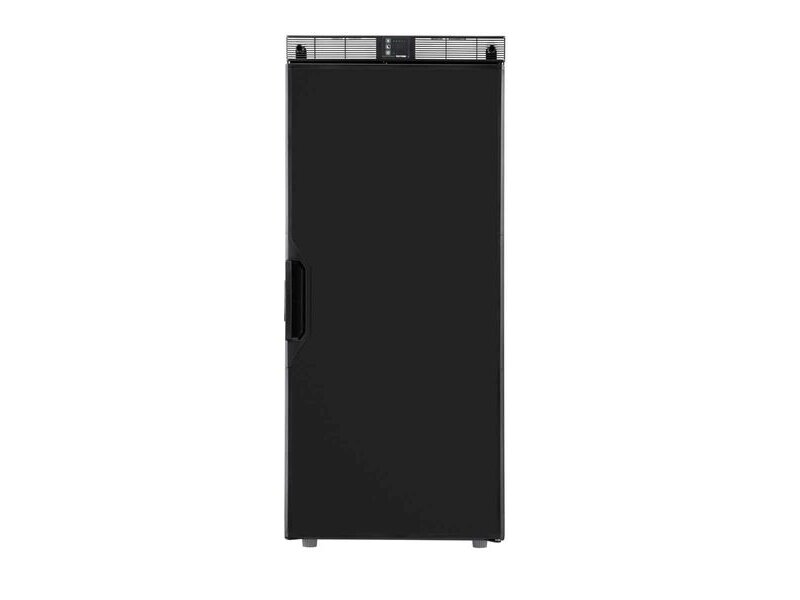
This technological shift is being driven by a core group of long-established names in mobile refrigeration, several of which feature in our range of compressor fridges and coolers. Thetford, whose European headquarters are in the Netherlands and long associated with motorhome toilets, launched its very first compressor fridge designed specifically for fitting into a converted van with the T1090, a sign that even brands historically tied to absorption are now investing in this space, with remarkably low noise levels, 32 dB(A) in standard operation and 29 dB(A) in night mode.
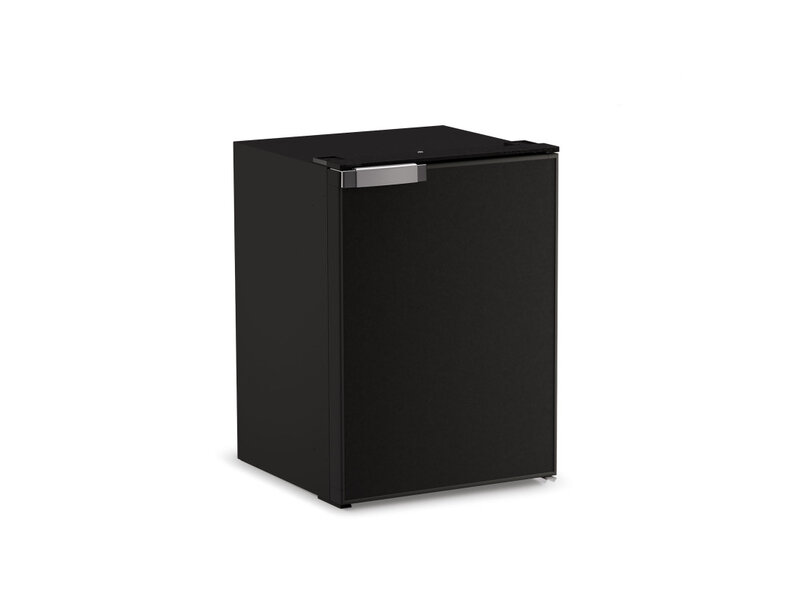
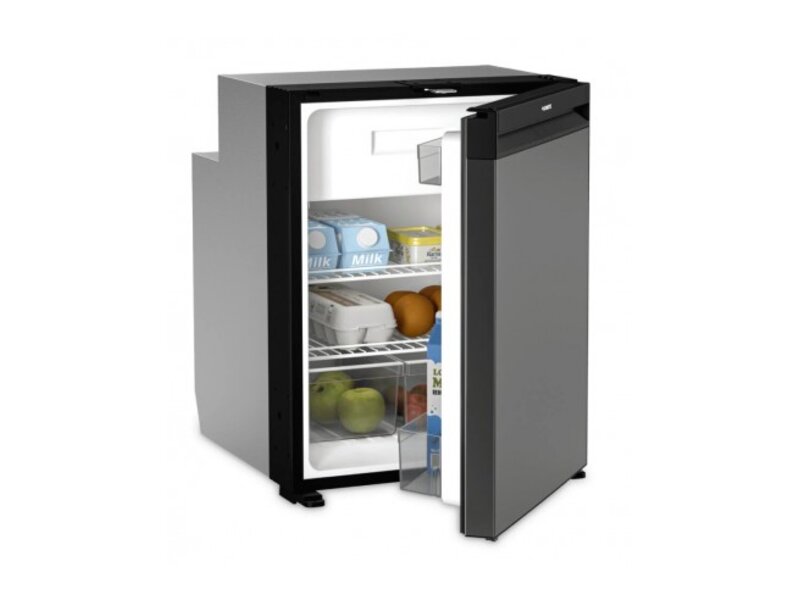
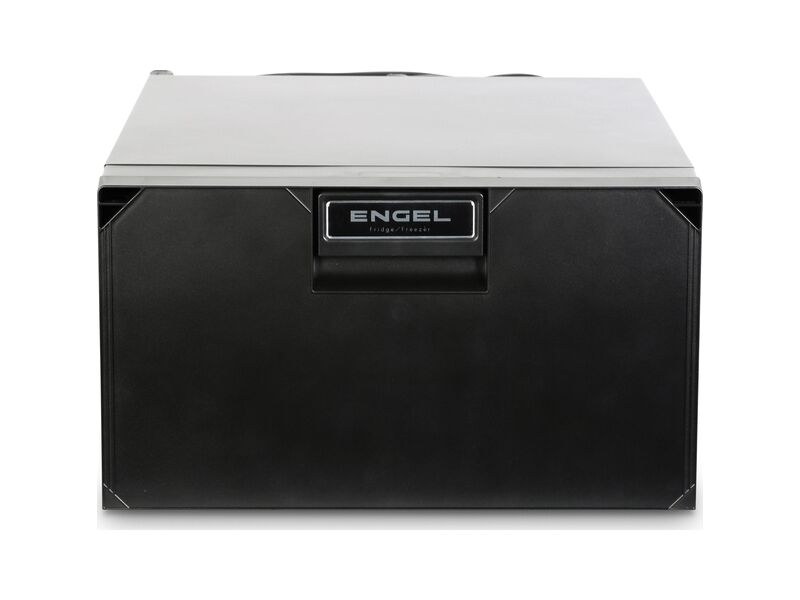
Vitrifrigo, the Italian firm with a long track record in marine and automotive refrigeration, offers the C39i, a built-in model with a particularly shallow depth, designed for compact vans such as the Transporter, Trafic or Expert. Dometic, the clear market leader, offers its built-in range through the NRX 80C, 75 litres with a removable freezer compartment and three operating modes, while Austria’s Engel, a pioneer of the swing compressor, offers the SB30F, a drawer format flush-mounted into the cabinetry, freeing up every available centimetre in a compact build.
What it changes for fitting out a van
For anyone converting their own van, the miniaturisation of compressors makes a real practical difference. An absorption fridge requires a dedicated outside ventilation space, high and low vents cut into the vehicle’s bodywork, to carry away the heat produced by the exchanger, plus a full gas installation if you want to use the gas mode: regulator, certified pipework, a leak test. A compressor fridge, by contrast, only needs an electrical supply and a simple vent for the compressor, which considerably simplifies the build, particularly for DIY conversions that would rather not cut into the bodywork for dedicated gas ventilation.
The drawer format or a remote-mounted compressor, as on the Engel SB30F, push this even further: the cold compartment can go anywhere in the kitchen cabinetry, while the bulkier compressor sits in a less accessible technical space, under the floor or inside a storage box. A flexibility that’s simply not achievable with a one-piece absorption unit.
The limits that remain
Compression hasn’t removed every constraint. The first thing to watch is electrical sizing. A compressor fridge does draw less power on average than an absorption model running on electricity, but it pulls noticeably higher current spikes when the compressor kicks in, which calls for a battery bank, ideally lithium, and, where possible, solar charging sized correctly for extended use with no mains connection.
Second point: the used market is still overwhelmingly fitted with absorption fridges, since the shift is mainly happening in new vehicles and recent conversions, leaving a large fleet of older vans still running on this long-established technology, with no need to replace it as long as it’s working properly. Finally, at comparable capacity and features, some premium compressor models still sit at a higher price point than an entry-level three-way fridge, even if that gap narrows every year as the technology becomes more mainstream.
A trend that’s here to stay
The direction of travel is clear and unlikely to reverse. As variable-speed compressors keep getting more compact and more efficient, and natural refrigerant gases become the norm under regulatory pressure, the compressor fridge is well on its way to becoming the standard in van life, with absorption increasingly confined to older, traditional motorhomes. A logical progression for a scene that keeps growing, and keeps demanding equipment that’s more compact, more self-sufficient and more efficient.
To go further, our article on how a compressor cooler actually works breaks down the refrigeration cycle step by step, and our compressor versus thermoelectric comparison broadens the picture to other off-grid uses.