
The refrigeration cycle in four steps
A compressor cooler is, at heart, a small standalone fridge, running on exactly the same physics as a kitchen fridge or an air conditioner: the vapour-compression refrigeration cycle. The principle is straightforward physics, a gas that is compressed heats up, a gas that expands cools down, exploited in a closed loop through four key components.
The compressor draws in the refrigerant gas at low pressure, in gas form, and compresses it mechanically. Like any gas that gets compressed, it heats up sharply: it leaves the compressor as a hot, high-pressure gas. That hot gas then flows through the condenser, a coil usually pressed against an outer wall of the cabinet: in contact with the cooler surrounding air, it gives up its heat and turns liquid, while still under high pressure.
That pressurised liquid then reaches the expansion valve, a simple capillary tube or a calibrated valve that forces a sudden pressure drop. This expansion causes a sharp drop in the liquid's temperature, much like an air-duster can that frosts over when emptied quickly. The liquid, now very cold and at low pressure, finally enters the evaporator, the coil sitting inside the insulated cabinet: it evaporates there, absorbing heat from the surrounding air and food, and it is precisely this heat transfer that produces the cold you feel inside the cooler. The gas, now warmed and back to low pressure, heads back to the compressor: the loop closes, running continuously as long as the unit is powered.
The role of the refrigerant gas: from R134a to R600a
The gas circulating in this closed loop, the refrigerant, matters both technically and environmentally. Recent compressor coolers, including the models in our compressor cooler range, overwhelmingly use R600a (isobutane), a natural hydrocarbon that has largely replaced older HFC gases such as R134a, which carry a far higher global warming potential (GWP).
The trade-off: R600a is flammable (safety class A3), which forces strict design rules, a gas charge limited to a few dozen grams, a circuit sealed at the factory, an evaporator the user can never access. In practice, this changes nothing for the end user: the circuit is hermetically sealed and needs no handling at all, except in case of a fault, which should always be left to a qualified technician.
Why compression reaches sub-zero temperatures, unlike Peltier coolers
Portable cooling actually spans several quite different technologies: absorption, the Peltier (thermoelectric) effect, and the compression cycle described above. Only compression relies on a genuine change of state of the fluid (liquid to gas and back), able to shift a large amount of heat on every cycle.
A Peltier plate works very differently: it exploits the thermoelectric effect of a semiconductor carrying a current, which creates a cold face and a hot face with no moving parts and no fluid at all. It is simple, quiet and cheap to build, but the temperature gap a Peltier plate can hold between inside and outside stays limited, typically 15 to 20 °C below ambient. On a hot summer day at 30 °C, a Peltier cooler will often plateau around 10 to 15 °C inside: fine for keeping drinks cool, nowhere near enough to freeze anything.
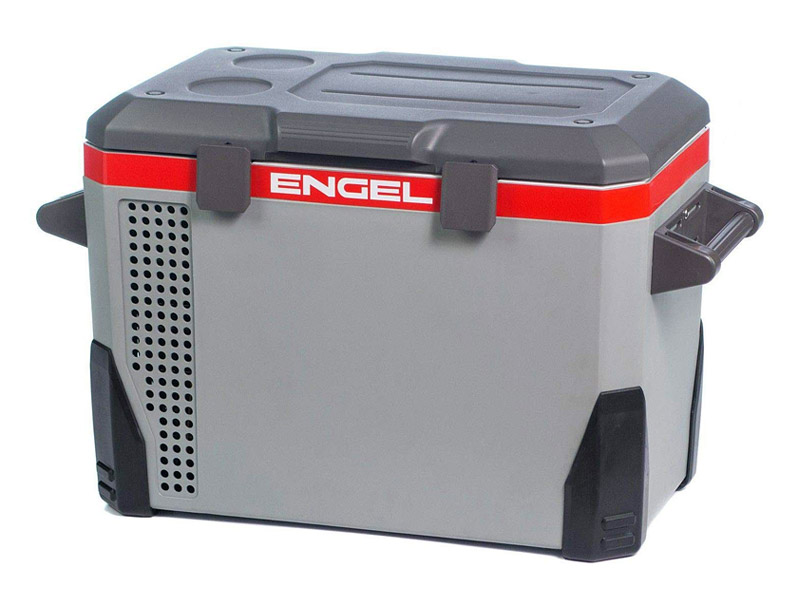
A compressor cooler, by contrast, is not tied to the outside temperature in the same way: its change-of-state cycle lets it reach genuine sub-zero temperatures, often down to -18 °C or even -22 °C depending on the model, whatever the ambient heat, within the compressor's design limits. That is why a compressor cooler such as the Engel MR-040F, adjustable from +10 °C to -18 °C, can double as a fridge or a freezer, a role no absorption or Peltier unit can fill.
Swing compressor or variable-speed compressor: what is the difference?
Not all cooler compressors are built the same. Two broad families share the market, with quite different philosophies.
The swing compressor (also called a boxer or oscillating compressor), popularised by the Austrian brand Engel, works through a straight back-and-forth motion, with no crankshaft or connecting rod. The result: very few moving parts, simple and rugged mechanics, known for exceptional longevity and for shrugging off vibration and tilting, a real advantage on a boat or on rough tracks. It usually runs on/off rather than fine-tuning its output.
The rotary variable-speed compressor, found on recent premium models such as Dometic's VMSO range, modulates its rotation speed continuously through an onboard control board. In practice, it runs hard to bring the temperature down quickly, then slows once the set point is reached, rather than stopping and restarting abruptly. The result: generally quieter running once at cruising temperature, finer temperature control, and often better energy efficiency over time.
| Criterion | Swing compressor (e.g. Engel) | Variable-speed compressor (e.g. Dometic VMSO) |
|---|---|---|
| Motion | Oscillating piston, straight back-and-forth | Rotary, speed modulated electronically |
| Control | On/off only | Speed continuously adjusted to cooling demand |
| Noise level | Moderate, audible cycling | Usually quieter at cruising speed |
| Mechanical robustness | Reputation for exceptional longevity, few electronic parts | Reliable, but more onboard electronics |
| Best for | Heavy use, marine environments, demanding conditions | Connected use, quiet running, fine efficiency |
Insulation: standard foam or vacuum insulated panels (VIP)
The compressor and the gas are not the whole story: without effective insulation, most of the cold produced would simply leak straight back out through the cabinet walls, forcing the compressor to run almost non-stop. Most compressor coolers use injected polyurethane foam between the inner and outer walls, a proven, inexpensive and effective solution, provided it is thick enough.
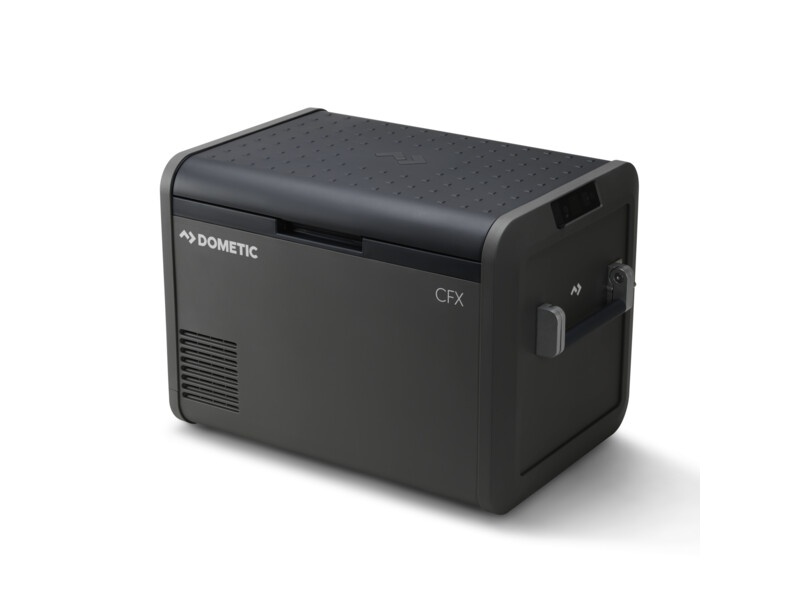
The newest, higher-end models, such as the Dometic CoolFreeze CFX5 55, add vacuum insulated panels (VIP) on certain walls. The principle is the same as a vacuum flask: a composite panel held under vacuum drastically limits thermal conduction, giving far better insulation than the same thickness of foam. The practical benefit: thinner walls for a given performance level, so more usable volume for the same outer footprint.
Why power consumption depends mainly on the temperature gap
A common misconception dies hard: people often assume a bigger cooler must use more power than a small one. In reality, the factor that weighs most heavily on power consumption is not the cabinet's volume, but the temperature gap between the target inside temperature and the outside air.
Two physical reasons explain this. First, the amount of heat leaking in through insulated walls is directly proportional to that temperature gap: the hotter it is outside and the colder inside, the harder heat 'pushes' its way in, whatever the size of the box. Second, and this is the less intuitive part, the efficiency of the compression cycle itself drops as the gap the compressor is asked to maintain grows: pulling heat out to reach -18 °C on a 35 °C day takes proportionally more mechanical work, and so more electricity, than holding +4 °C under the same conditions.
In practice, a cooler set to freezer mode (-18 °C to -20 °C) will use noticeably more power than the same unit set to fridge mode (+4 °C to +6 °C), for an identical volume. That is also why a well-insulated cooler run at a moderate temperature can use less power than a smaller but poorly insulated one pushed into sub-zero territory. On the road, the single best habit for preserving battery life is to only aim for the temperature you actually need, not the lowest one on principle.
Which compressor should you choose?
In practice, not every use case demands the same level of technical rigour. For heavy, demanding use (sailing, expeditions, professional applications), the proven mechanical toughness of a classic swing compressor such as the one in the Engel MR-040F remains a safe bet, even at a higher weight and price. For connected, comfortable use in a campervan or motorhome, a variable-speed rotary compressor paired with VIP insulation, as on the Dometic CoolFreeze CFX5 55, strikes an excellent balance between quiet running, efficiency and smart features.
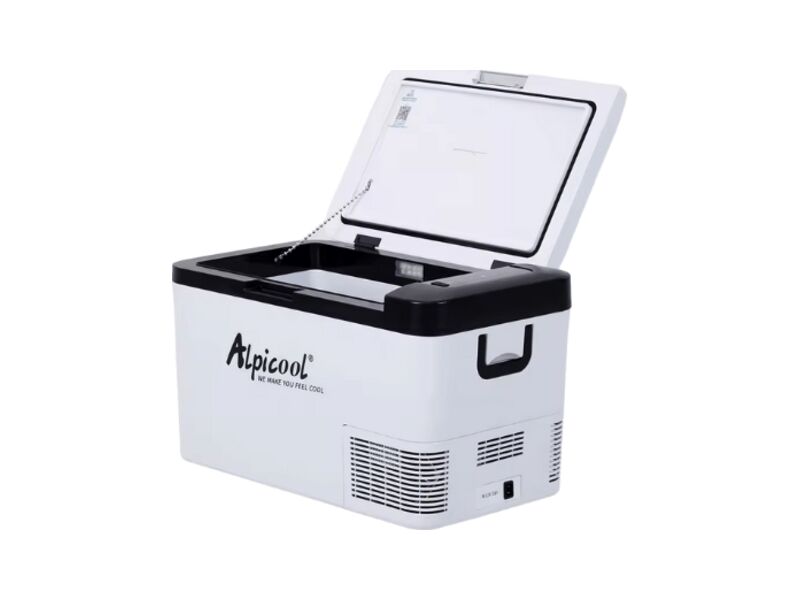
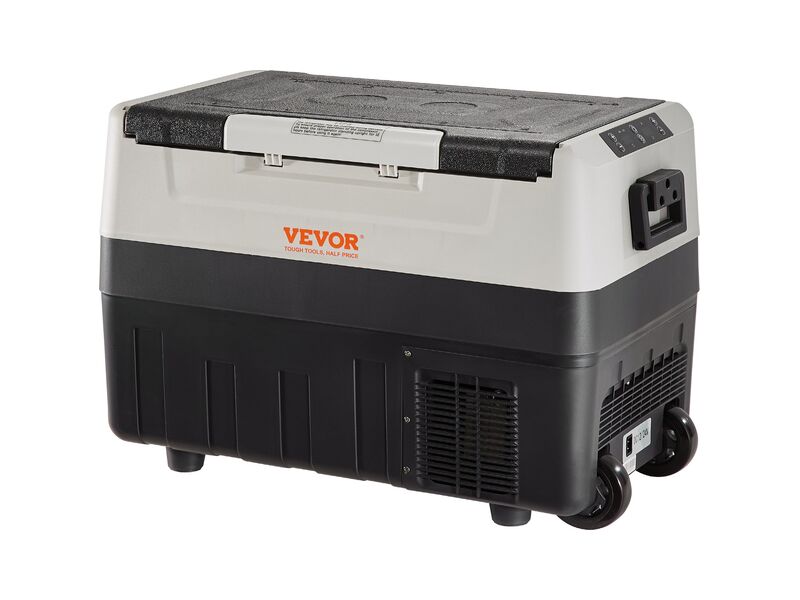
For a first purchase or a tighter budget, proven compressors such as the LG unit fitted to the Alpicool K25 or general-purpose coolers like the Vevor 45L deliver a genuinely reliable compressor without the price tag of the historic brands. Either way, remember the compressor is only one piece of the puzzle: insulation, the refrigerant used, and above all the temperature gap you're asking for, matter just as much for real-world performance. To go further on cooling appliance efficiency in general, our guide to energy labels for cooling appliances explains how the EU energy label is calculated and read.